Business
Preparing for Google Zero
Google Zero is reshaping publishing. Discover how to monetize bot traffic, build owned audiences, and thrive in the answer engine era.
Explore the dual-edged sword vibe coding, where democratization invites both creativity and chaos, highlighting the need for expertise amidst innovation.

In the Pixar classic Ratatouille, Chef Gusteau famously championed the mantra, "Anyone can cook." But by the end of the film, food critic Anton Ego clarifies the true meaning: “Not everyone can become a great artist, but a great artist can come from anywhere.”
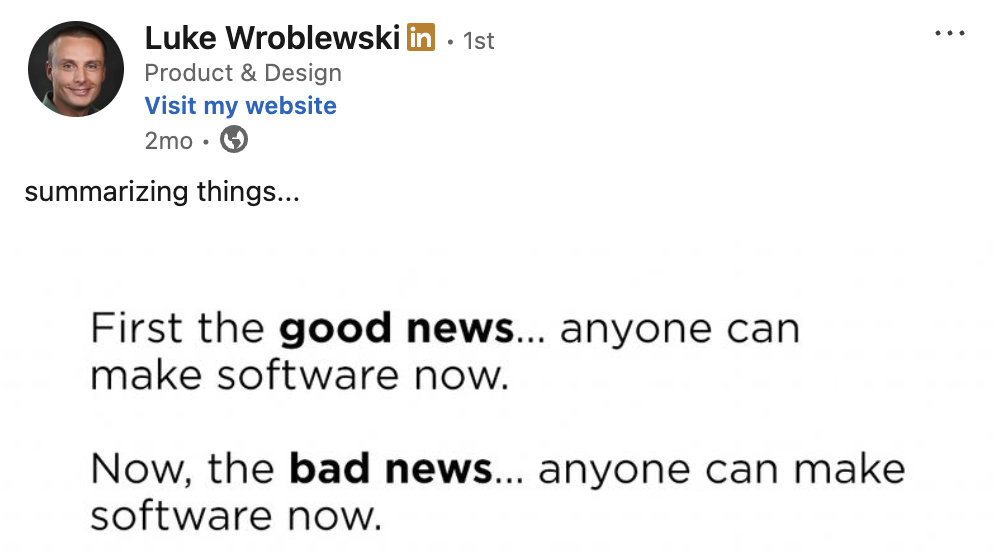
In 2026, we have reached the Silicon Valley equivalent: Anyone can code. Thanks to GenAI, the barrier to entry for software development has been blown up. But as we survey the landscape of this agentic era, we are discovering as Luke Wroblewski pointed out that while the good news is that anyone can code, the bad news is… anyone can code.
Diving a little deeper, the democratization of coding feels like a dangerous sequel to the mid-2000s, and "vibe coding" is currently cooking up a lot of burned food.
Wall Street is currently obsessed with a singular, apocalyptic view of the impact of AI on the world. As MarketWatch recently noted, there is a growing fear that "AI will eat software"—the theory being that if everyone becomes their own developer, the $600 billion software industry collapses under the weight of DIY alternatives.
But we’ve seen this movie before. In the mid-2000s, the open-source revolution allowed unqualified users to deploy complex projects like Drupal and WordPress with just a few clicks. It introduced massive power, but it was power without understanding and the result was a decade of hacked sites because people were deploying technology they didn't know how to secure.
We are seeing that same friction-less creation today. As the technology publication Runtime reports, "AI slop" is currently overwhelming open-source communities, flooding repositories with low-quality, unverified code. The threat isn't that software is being replaced, it's that our community contributed digital infrastructure is being buried by an avalanche of mediocre and malicious code.
In that mid-2000s era, much of our tech survived simply because it was too edge case to target; you didn't fix the leak in the back of the kitchen because no one knew the pipe was there. AI marks the end of the security through obscurity era, with no security hole being too small to target.
When anyone can code, everyone also has access to a small army of expert agents. AI is now being used to exploit both new "amateur" code and existing legacy systems at a speed humans can't match. If an AI can write a functional app in seconds, it can also find a vulnerability in your middleware in seconds.
This brings us to the divide between the vibe code fantasy and the CIO reality. As I wrote recently, CIOs are allergic to the AI-bro fantasy because moving from a known software platform to a custom AI stack involves moving from the known to the unknown. This risk makes it unlikely that core elements of the technology stack will be torn out and rewritten.
However, the real promise of AI is that technology can finally focus on solving problems in the way humans prefer. It should mean the end of the dreaded "call tree" (Press 1 for Sales, Press 2 to wait forever). It should mean interfaces that adapt to us. We are already seeing this in the move from Search Engines to Answer Engines.
Just as we had to survive years of mishandled open source before reaching the professionalized web of today, we are likely entering a period of burned and bland digital food known as AI slop.
During this time, its not only ok, but a good idea to ask for professional help. Great chefs can come from anywhere, but the best restaurants employ experienced chefs not only to prevent guests from getting food poisoning, but to ensure an amazing overall experience.
Google Zero is reshaping publishing. Discover how to monetize bot traffic, build owned audiences, and thrive in the answer engine era.
Explore why replacing human workers with AI can harm companies, and learn how pairing AI with human talent is the key to sustainable success.
Discover how Accedo leverages AWS cloud services to drive innovation and enhance consumer experiences in the media and entertainment industry.